





comunicados
PORTADA_COMUNICADO_PRINCIPAL
COMUNICADOS_2026_BL5
Comunicados 2026
FIMPES awarded ITESO its highest accreditation for the fifth time
A day dedicated to recognizing the importance of women in the public and private life of the country
March 8: International Women's Day
ITESO reaffirms its commitment to building a peaceful Mexico
The university resumes its in-person activities
ITESO will continue its online activities
ITESO suspends in-person activities on Monday, February 23
Statement regarding the acts of violence in the State
Measles vaccination day at ITESO
Let's continue to take care of everyone's health.
Comunicado final del Segundo Diálogo Nacional por la Paz
Obras en la lateral del Periférico
ITESO Editorial Team
The Federation of Mexican Private Institutions of Higher Education (FIMPES) awarded ITESO the A7 Accreditation. This is the highest level granted by this organization and is valid for seven years.
The result of the accreditation process shows that ITESO is a university committed to educational excellence and confirms that we have systematic planning and evaluation processes for the continuous improvement of the service we provide to society.
Our thanks to the more than 70 colleagues who worked directly on the preparation of the self-study, as well as to members of staff, students, faculty, graduates and employers, whose participation in the study helped to show the ideal results of our training processes.
We also recognize and appreciate the work of the evaluators who carefully reviewed our self-study report, as well as the FIMPES representative who accompanied us throughout the process.
The FIMPES accreditation, which we have received for the fifth time, is not only a recognition of the academic quality and comprehensive training provided by ITESO, but it is also an incentive for our community to improve and continue working diligently in fulfilling our Mission, inspired by our Fundamental Orientations.
To the university community:
In the context of March 8, International Women's Day, and as it has done in previous years, ITESO joins the spaces for reflection and dialogue promoted by different areas of the university, with the purpose of strengthening a university culture based on dignity, equality and respect for human rights.
In this context, March 9th has become established in Mexico as the day of social reflection known as "A Day Without Us," which arose from the mobilization of women seeking to make visible gender violence, structural inequalities, and the relevance of women's participation in the public and private life of the country.
The day of action on March 9th is marked by a work stoppage by women in their academic, professional, consumer, and domestic activities. This symbolic action aims to highlight the social, economic, and community impact of their daily contributions. This collective exercise has also been recognized as a call for institutional responsibility to strengthen policies promoting equality and preventing violence.
From a human rights perspective, this day represents an opportunity to reaffirm the commitment to eradicating violence against women and girls, as well as to building fairer, safer and more inclusive environments.
In accordance with these principles, ITESO joins the activities that will take place within the framework of March 8, and fully recognizes the social and symbolic meaning of the day of March 9 as a legitimate space for visibility, reflection and collective awareness.
While continuing to promote concrete actions in its daily operations, the university reaffirms its commitment to building institutional conditions that foster substantive equality, prevent violence, and ensure the unrestricted respect for women's rights. At ITESO, we recognize that this path involves complex processes of institutional change, marked by persistent tensions and resistance that challenge us and compel us to continue critically examining our practices, structures, and decisions.
Therefore, there will be no academic or employment implications for students, teachers, and staff who decide to participate in this strike.
We invite all members of the university community to conduct themselves respectfully during the activities held on those dates, to participate in the dialogue spaces, and to assume the shared commitment to continue building a more just university and society, free from violence and discrimination.
With respect and solidarity,
Tlaquepaque, Jalisco, March 5, 2026.
March 8th is officially commemorated as International Women's Day. This day, which coincides with the International Day for the Elimination of Violence against Women, serves as a constant reminder of the challenges we face as a society in eradicating discrimination and violence against girls and women. Numerous studies demonstrate the persistent gender inequality gaps in our country and around the world. For example, the "Concluding Observations on Mexico's Tenth Periodic Report," published last July by the Committee on the Elimination of Discrimination against Women (CEDAW Committee), outline a series of obstacles to the full enjoyment of the rights of girls and women and have urged the Mexican State to redouble its efforts in various areas, including the education sector.
Among other calls, the CEDAW Committee urges the adoption of a comprehensive national strategy to eliminate gender stereotypes in curricula and educational guidance, ensuring the systematic integration of human rights education and promoting girls' participation in science, technology, engineering, and mathematics (STEM) disciplines. This includes higher education institutions and aligns with the values and vision of ITESO, a university entrusted to the Society of Jesus, which promotes a humanistic approach and is guided by Fundamental Orientations that enshrine social commitment and a pedagogy based on awareness, freedom, participation, and dialogue.
For this reason, on September 17 of last year, Alexander Paul Zatyrka Pacheco, SJ, Rector of ITESO, created the Institutional Program for Gender Equality, continuing the reflections and sustained efforts of departments, groups, and individuals within the university community who, in previous years, paved the way and laid the foundations for this process. This program aims to further promote an institutional culture that fosters gender equality and respect among all people, in the spirit embodied by the Framework for Egalitarian University Coexistence.
The program is comprised of five people and aims to be a space for connection, coordination, and support for multiple initiatives underway at ITESO, as well as those that may be implemented in the future. As part of its initial actions, it has prioritized dialogue with various members of the university community. This will allow it to gather experiences, contributions, best practices, and recommendations, thus collecting important input for outlining its work plan in the coming months.
It is important to remember that it is the responsibility of everyone in the university community to contribute to a culture of respect and equality. This is demonstrated by the diverse activities that will take place within the framework of International Women's Day (March 8th) under the theme "Everyday Actions of Peace and Justice that Transform the World."
For those who decide to participate in the march on Sunday, March 8, we inform you that Casa ITESO Madero, located at Madero 836, in the Americana neighborhood, next to the Expiatory Temple, will be open from 6:00 p.m. to 10:00 p.m. so you can hydrate, rest, or use the restrooms. A valid ITESO student or staff ID will be required for entry.
While we continue to face challenges, it is also important to acknowledge the progress we have made. The statement issued to announce the creation of the program expresses gratitude for “the support of the university community for initiatives that allow us to continue advancing in a culture of equity, inclusion, and respect,” while also calling “on students, academic and administrative staff, and those who provide services in positions of authority to join the initiatives and actions carried out by the program with openness, commitment, and dialogue.”
We invite the entire university community to join this call so that, together, through awareness-raising, reflection, research, and advocacy, we can continue building safe spaces free from stereotypes, discrimination, and violence. The 8M activities can be found at https://agenda.iteso.mx/ .
Tlaquepaque, Jalisco, March 3, 2026.
To the university community:
We hope that everyone who studies and works at ITESO and their families are well. The university thanks them for their effort and commitment to resuming our daily activities with the care and solidarity that characterize us as a community.
Each person copes differently with the situation they've experienced in recent days, and listening is crucial to beginning the recovery process. Therefore, the university offers the following support resources:
• Ignatian University Center (CUI): 33 3669 3546 https://www.iteso.mx/web/cui
• Center for Youth Support and Studies (C-Juven): api@iteso.mx | WhatsApp 52 (1) 33 2935 9462 | https://cjuven.iteso.mx/
• Center for Academic Excellence Support (CAXA): caxa@iteso.mx | +52 33 3669 3434, ext. 4119 | https://caxa.iteso.mx/
• Coordination for Reconciliation for a Culture of Peace (Cerpaz) paulinaqt@iteso.mx
• Psychology Network in connection with professors: psicologia@iteso.mx | nodosenred@iteso.mx
Furthermore, we invite you to participate in the reflection and horizontal listening circles that will take place on March 2nd, 3rd, and 4th. Details of these and other activities of support and mutual care will be shared through our institutional communication channels: Radio ITESO 95.1 , agenda.iteso.mx , Instagram and Facebook (@itesouniversidad), cruce.iteso.mx , and facebook.com/CruceITESO .
Activities on campus will continue as normal. If anyone is facing extraordinary circumstances that make it difficult for them to return to in-person activities, please contact the appropriate person.
• The students, in coordination with their educational program.
• The teaching staff with their teaching coordination.
• Academic, administrative and support services staff, with the head of their department.
In dialogue, alternatives can be explored to give continuity to training or work processes, always prioritizing the care of people.
Off-campus activities will remain suspended until further notice. We are closely monitoring the situation in the state of Jalisco and will keep you informed as soon as we can resume these activities.
Resuming daily life does not mean normalizing violence. We cannot become accustomed to it as a society. At ITESO, we maintain the conviction and hope that it is possible to build a Mexico at peace, with justice and dignity for all people, and we reaffirm our commitment to working toward this goal through our university work.
As a community, we can rely on the responsibility and solidarity that have always characterized us.
We all take care of each other.
To the University Community
In accordance with the provisions of the Government of the State of Jalisco, tomorrow, Wednesday, February 25, 2026, in-person activities will resume in all areas of ITESO.
All facilities will be operating at 100 percent capacity, including the Technology Park, Casa ITESO Clavigero, Centro Polanco, and Casa ITESO Madero. University transportation will maintain its regular routes and schedules.
Activities planned outside the Guadalajara Metropolitan Area must be rescheduled until further notice, while those planned to take place within the Guadalajara Metropolitan Area will be evaluated individually by the authorities of each agency, considering the conditions and needs of each case.
Likewise, support will continue to be provided to students from other countries who have any difficulty returning to Guadalajara, so it is important that they stay in contact with the coordinators of their educational programs.
As a measure that promotes safety and community care, we recommend the shared use of private vehicles on journeys to and from the campus; for this you can use the Allride application, available on iOS and Android.
For the resumption of our daily activities, we rely on the responsibility and solidarity that characterize us as a university community.
We all take care of each other.
Tlaquepaque, Jalisco, February 24, 2026.
To the University Community
Based on the close monitoring of the situation in the Guadalajara Metropolitan Area and in various regions of the state, we inform the university community that academic, administrative and support services will continue to be carried out remotely until the competent authorities confirm that there are safe conditions to resume in-person activities.
In the specific cases of foreign students who face any difficulty connecting to their classes, we ask them to contact the coordinators of their educational programs in order to receive the necessary support and assistance.
In light of recent events, we reject all forms of violence in the state of Jalisco and throughout the Republic, and we express our solidarity with the people and communities that have been affected.
True to our commitment to building peace, at ITESO we reiterate our willingness to collaborate with society, from our position as an educational institution, in preserving the rule of law and in seeking conditions that guarantee the tranquility and peaceful coexistence of the population.
We all take care of each other.
Tlaquepaque, Jalisco, February 23, 2026.
Tlaquepaque, Jalisco, February 22, 2026
To the University Community:
Following the acts of violence recorded today in the Guadalajara Metropolitan Area and in various regions of the state of Jalisco, ITESO informs that on Monday, February 23, 2026, all face-to-face activities at the University are suspended .
Where possible, classes will be moved to a distance learning format, using the usual channels and digital platforms. When this is not feasible, teachers, in agreement with their coordinators, will define strategies for making up missed sessions and covering missing content.
Academic staff will be in contact with their groups to confirm the details of each session.
In the case of administrative and support services staff, the specific way to monitor their activities online will be agreed upon in each department.
This decision has been made to protect the integrity of our university community and in compliance with the provisions of the Jalisco Ministry of Education, which determined the suspension of in-person classes at all educational institutions in the state.
ITESO will continue to monitor the situation and will promptly communicate any decisions made regarding subsequent days and the return to in-person activities.
We reiterate our call to remain calm, stay home as much as possible, and seek information exclusively from official sources and channels. We ask you to avoid spreading rumors or unverified information.
We all take care of each other.
Statement 01 - Regarding the acts of violence in the State
Tlaquepaque, Jalisco, February 22, 2026
To the university community:
In light of the acts of violence that occurred today in the Guadalajara Metropolitan Area and in various parts of the state of Jalisco, ITESO expresses its solidarity with all those affected and shares the following guidelines with its university community:
First and foremost, we urge everyone to remain calm. It is understandable that moments like this generate uncertainty and concern; however, acting with composure is essential for making responsible decisions that protect our well-being and that of those around us.
We strongly recommend staying home as much as possible and avoiding any non-essential travel. We also urge the entire community to stay informed only through official sources and verified media outlets, and to refrain from sharing rumors or unconfirmed information that could cause further alarm or confusion.
We especially ask that international students maintain constant communication with their families so that their loved ones can be certain of their well-being and location. Those who are in their hometowns, please remain there until further notice.
ITESO is closely monitoring the situation and will promptly notify the community of any developments they may need to consider in carrying out their activities.
At all times, we rely on the responsibility that characterizes us as a community. We all take care of each other.
With the support of Family Medicine Unit No. 91 of the IMSS, a measles vaccination campaign will be held at the ITESO Medical Services (building L, next to the Central Cafeteria) on the following days and times:
• Friday, February 13, from 2:00 p.m. to 7:00 p.m.
• Monday, February 16th, from 2:00 PM to 7:00 PM.
• Tuesday, February 17th, from 9:15 a.m. to 7:00 p.m.
These days, vaccines against tetanus and influenza will also be available.
1- Who is this campaign aimed at?
Students, faculty, and staff on campus. Minors will not be vaccinated during those hours as parental or guardian authorization is required.
2- Who are candidates to receive the vaccine?
The doses will be administered until stocks run out, and priority will be given to those who:
• They have an incomplete schedule (1 or no doses), or they don't remember if they have received both doses.
• Be under 49 years old.
3- What is needed to receive the vaccine?
• Bring your vaccination card.
• Even if you don't have a vaccination card, you can still get vaccinated.
• No appointment is necessary; vaccinations will be administered on a first-come, first-served basis at the Medical Services.
4- Who are NOT candidates for measles vaccination in this campaign?
• Those who have a complete schedule (2 doses).
• Those who have already suffered from the disease.
5- Who CANNOT get the vaccine?
• They are pregnant.
• They have diseases that weaken the immune system.
• They are being treated with medications that suppress the immune system.
• They have a history of severe allergy to this vaccine or to egg protein.
• Those who feel significantly ill with fever on the day of vaccination should postpone the vaccination.
We appreciate your cooperation in ensuring that the day is carried out in an orderly and safe manner.
If you have any questions, please contact the ITESO Medical Services Coordination: serviciosmedicos@iteso.mx
Statement 01 - Let's continue taking care of everyone's health // February 5, 2026
Tlaquepaque, Jalisco, February 5, 2026
To the university community:
We encourage you to continue joining efforts to prevent measles infections, which, in the case of Jalisco, continue to rise. Vaccination is the most effective measure; it is very important that those who have not completed their vaccination schedule receive the missing doses. To do so, you can go at any time to the health centers in the Guadalajara Metropolitan Area (ZMG), or to the vaccination sites that the state government has set up at various locations throughout the city.
The use of face masks in enclosed spaces, such as classrooms, auditoriums and offices (preferably KN95 or three-layer) is highly recommended, as the disease is mainly transmitted through the respiratory system.
Hand hygiene (frequent washing, use of antibacterial gel, etc.) and isolation in case of symptoms such as fever, cough, white spots in the mouth or skin rash (report these situations to serviciosmedicos@iteso.mx and the educational program coordination), are also very important measures that we can all implement.
Healthcare is a shared responsibility. We appreciate your willingness to contribute to actions that protect our university community.
Stay informed through official social media channels.
Sincerely:
Medical Services Coordination, Personnel Office
Guadalajara, Jalisco, 1 de febrero de 2026.
Del 30 de enero al 1 de febrero, en el ITESO, Universidad Jesuita de Guadalajara, más de 1,200 líderes sociales, religiosos, académicos, empresariales, autoridades locales y representantes de la sociedad civil provenientes de todo el país se reunieron en el Segundo Diálogo Nacional por la Paz, un espacio plural para mirar de frente la realidad de la violencia en México, compartir metodologías de construcción de paz y articular respuestas a la altura del momento histórico que vive la nación.
El encuentro reunió voces de todas las regiones del país, reflejando la diversidad de contextos, dolores y esperanzas que hoy atraviesan a México, con un objetivo común: reconstruir la paz desde lo local, con visión nacional y compromiso colectivo.
Durante el Diálogo se llevaron a cabo tres conferencias magistrales.
El académico Mauricio Merino abordó las causas estructurales de la violencia en México, subrayando la urgencia de recuperar al Estado como un espacio de acuerdos colectivos que dé marco institucional a la vida social. El sacerdote Elías López reflexionó sobre los desafíos de la reconciliación nacional, destacando la necesidad de formar liderazgos comunitarios y sinodales capaces de construir propuestas desde la escucha.
Por su parte, Monseñor Ramón Castro enfatizó que construir la paz exige escuchar, discernir y actuar, es una vocación de toda persona para buscar un orden social de relaciones armonizadas, poniendo en el centro a las víctimas y convencidos que la paz solo se alcanza si hay verdad, justicia y reparación.
Asimismo, se desarrollaron mesas de análisis sobre los principales desafíos del país. El Dr. Alfonso Alfaro llamó a imaginar un Estado capaz de integrar a los jóvenes hoy atrapados por la violencia. Sandra Ley señaló la urgencia de fortalecer a las policías municipales. Sergio López Ayllón propuso la justicia cívica como una vía concreta desde lo local. Daniel Moreno subrayó la importancia de incorporar a los medios de comunicación como actores estratégicos en la construcción de paz. Alberto Olvera llamó a fortalecer las alianzas con la sociedad civil. Elena Azaola recordó la deuda pendiente con las cárceles. Sara González, universitaria, expuso los retos para activar la participación juvenil. Y José Medina Mora presentó el Modelo Inclusivo de Desarrollo como una contribución del sector empresarial a la paz.
En tres mesas adicionales se compartieron experiencias nacionales e internacionales de construcción de paz, confirmando que existen caminos viables con resultados concretos en los territorios. Entre ellas destacaron el Proyecto VIVA y los Centros Manresa en la Sierra Tarahumara, que han atendido a más de 8,000 personas en salud mental, así como experiencias de colaboración en el diseño de Consejos de Paz y Justicia Cívica con el gobierno federal. Los embajadores de Irlanda, Ruairí De Burca, y de Noruega, Dag Nylander, coincidieron en que todo proceso de paz debe construirse junto a las víctimas de la violencia y ofrecer caminos de reinserción para los victimarios.
El Diálogo contó también con la presencia de alcaldes y representantes municipales reconocidos por su trabajo en la construcción de la paz, provenientes de Centro, Tabasco; Escobedo y San Pedro Garza García, Nuevo León; Guadalajara, Zapopan y Jocotepec, Jalisco; Meoqui, Chihuahua; Cherán, Michoacán; y Tepoztlán, Morelos, quienes se sumaron a este esfuerzo como actores clave desde lo local.
De igual manera, diversas comunidades religiosas firmaron un compromiso común y presentaron un plan de trabajo conjunto. Participaron representantes de comunidades budistas, musulmanas, hinduistas, de la Iglesia de Jesucristo de los Santos de los Últimos Días, tradiciones indígenas, comunidad ortodoxa, bautista, luterana, pentecostal y católica quienes se comprometieron a formarse frente a los desafíos de la violencia, aportar la riqueza ética de sus espiritualidades y fomentar el encuentro desde la diversidad religiosa en México.
En el marco del encuentro se entregaron reconocimientos a 13 empresas comprometidas con la construcción de una cultura de paz en sus entornos. Este distintivo fue entregado por CONCANACO-SERVYTUR, COPARMEX, CANACINTRA y USEM, y las empresas ganadoras fueron: La Norteñita, Bio TecLab, CEDIMI Laboratorios, Centro de Acopio y Soluciones Ambientales, Combuservicios, Controladora Vía Rápida Poetas, Criser, Estructuras Metálicas de Puebla, Grupo La Paz, La Vencedora, Restaurante Mar y Tierra, Talentoría y Desarrolladora Comuna.
Las metodologías de construcción de paz sistematizadas por este movimiento serán entregadas al gobierno federal, a los gobiernos estatales y a los gobiernos municipales del país aportando con ellas caminos para construcción de la paz desde programas probados en la atención de las violencias. Así como se entregaron a los 9 alcaldes presentes en el Diálogo Nacional por la Paz.
En las conclusiones se destacó que el gran reto es imaginar y reconstruir el Estado que México necesita para recuperar la paz, a partir de acuerdos que regulen la vida institucional y garanticen condiciones de vida digna para todas las personas.
Este segundo encuentro dejó tres claves fundamentales:
1. El Estado somos todas y todos, y la paz exige acuerdos colectivos desde lo local, esto implica la conversión de quienes lucran con la violencia y quienes permanecen indiferentes ante ella.
2. Es urgente construir un sistema social que integre a las juventudes hoy excluidas y vulnerables, y ahí es importante escucharlos y construir junto con ellos.
3. No será posible una nueva convivencia sin atender y sanar la herida de las personas desaparecidas y acompañar de manera prioritaria a las víctimas de la violencia.
El encuentro concluyó con la lectura de un manifiesto, en el que se afirmó que el camino hacia la paz pasa por refundar la comunidad desde la escucha, el reconocimiento y el compromiso, abrir horizontes de esperanza para las juventudes y caminar del lado de las víctimas, teniendo como eje transversal la cultura del cuidado.
Descarga este comunicado en formato .pdf aquí
Diálogo Nacional por la Paz
dialogonacionalporlapaz.org.mx
Tlaquepaque, Jalisco, a 14 de enero de 2026
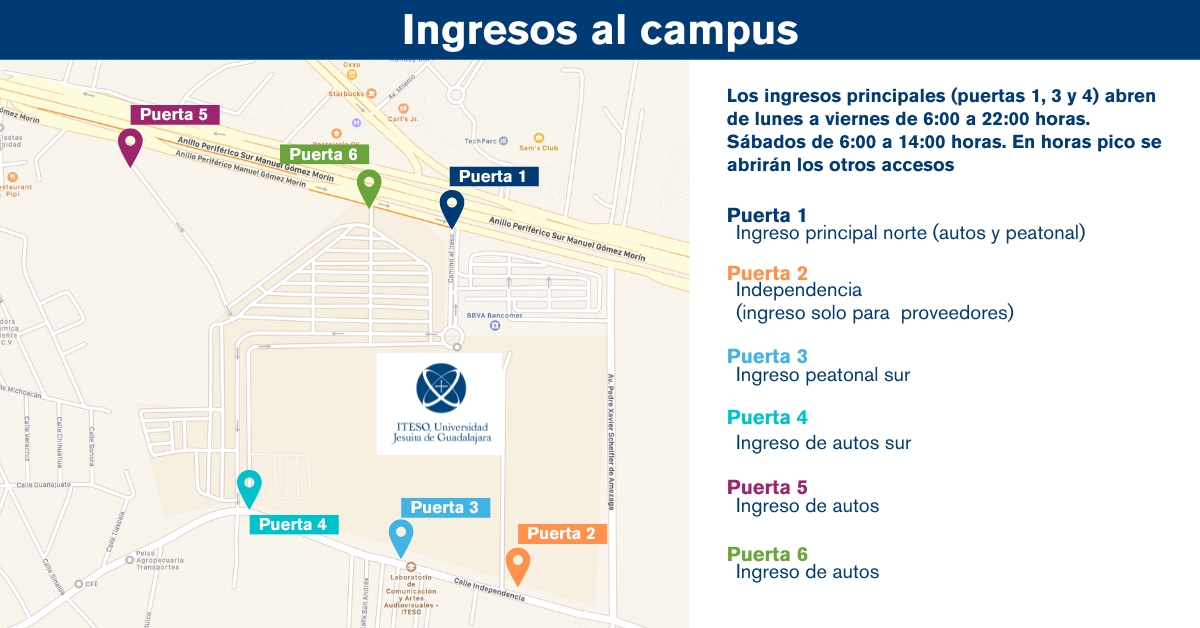
Actualmente, la construcción que está edificándose al lado del ITESO lleva a cabo una obra en la lateral del Periférico, justo antes del acceso principal al campus. Estos trabajos obras han reducido la circulación a un solo carril, lo que genera congestionamientos importantes en la zona durante las horas de mayor afluencia. Se espera que los trabajos se extiendan al menos tres semanas más.
En anticipación al inicio del semestre, recomendamos considerar tiempos de traslado más amplios para llegar puntualmente a las actividades académicas. Les recordamos que el campus cuenta con accesos alternos que pueden facilitar el ingreso y reducir los tiempos de espera. Asimismo, el servicio de transporte universitario está disponible y representa una excelente opción para evitar contratiempos.
Invitamos a toda la comunidad a compartir vehículos siempre que sea posible a través de la aplicación de AllRide, contribuyendo así a disminuir el tráfico y a fomentar prácticas de movilidad sustentable.
Agradecemos su comprensión y colaboración.
Comunicados 2026
ITESO Editorial Team
The Federation of Mexican Private Institutions of Higher Education (FIMPES) awarded ITESO the A7 Accreditation. This is the highest level granted by this organization and is valid for seven years.
The result of the accreditation process shows that ITESO is a university committed to educational excellence and confirms that we have systematic planning and evaluation processes for the continuous improvement of the service we provide to society.
Our thanks to the more than 70 colleagues who worked directly on the preparation of the self-study, as well as to members of staff, students, faculty, graduates and employers, whose participation in the study helped to show the ideal results of our training processes.
We also recognize and appreciate the work of the evaluators who carefully reviewed our self-study report, as well as the FIMPES representative who accompanied us throughout the process.
The FIMPES accreditation, which we have received for the fifth time, is not only a recognition of the academic quality and comprehensive training provided by ITESO, but it is also an incentive for our community to improve and continue working diligently in fulfilling our Mission, inspired by our Fundamental Orientations.
To the university community:
In the context of March 8, International Women's Day, and as it has done in previous years, ITESO joins the spaces for reflection and dialogue promoted by different areas of the university, with the purpose of strengthening a university culture based on dignity, equality and respect for human rights.
In this context, March 9th has become established in Mexico as the day of social reflection known as "A Day Without Us," which arose from the mobilization of women seeking to make visible gender violence, structural inequalities, and the relevance of women's participation in the public and private life of the country.
The day of action on March 9th is marked by a work stoppage by women in their academic, professional, consumer, and domestic activities. This symbolic action aims to highlight the social, economic, and community impact of their daily contributions. This collective exercise has also been recognized as a call for institutional responsibility to strengthen policies promoting equality and preventing violence.
From a human rights perspective, this day represents an opportunity to reaffirm the commitment to eradicating violence against women and girls, as well as to building fairer, safer and more inclusive environments.
In accordance with these principles, ITESO joins the activities that will take place within the framework of March 8, and fully recognizes the social and symbolic meaning of the day of March 9 as a legitimate space for visibility, reflection and collective awareness.
While continuing to promote concrete actions in its daily operations, the university reaffirms its commitment to building institutional conditions that foster substantive equality, prevent violence, and ensure the unrestricted respect for women's rights. At ITESO, we recognize that this path involves complex processes of institutional change, marked by persistent tensions and resistance that challenge us and compel us to continue critically examining our practices, structures, and decisions.
Therefore, there will be no academic or employment implications for students, teachers, and staff who decide to participate in this strike.
We invite all members of the university community to conduct themselves respectfully during the activities held on those dates, to participate in the dialogue spaces, and to assume the shared commitment to continue building a more just university and society, free from violence and discrimination.
With respect and solidarity,
Tlaquepaque, Jalisco, March 5, 2026.
March 8th is officially commemorated as International Women's Day. This day, which coincides with the International Day for the Elimination of Violence against Women, serves as a constant reminder of the challenges we face as a society in eradicating discrimination and violence against girls and women. Numerous studies demonstrate the persistent gender inequality gaps in our country and around the world. For example, the "Concluding Observations on Mexico's Tenth Periodic Report," published last July by the Committee on the Elimination of Discrimination against Women (CEDAW Committee), outline a series of obstacles to the full enjoyment of the rights of girls and women and have urged the Mexican State to redouble its efforts in various areas, including the education sector.
Among other calls, the CEDAW Committee urges the adoption of a comprehensive national strategy to eliminate gender stereotypes in curricula and educational guidance, ensuring the systematic integration of human rights education and promoting girls' participation in science, technology, engineering, and mathematics (STEM) disciplines. This includes higher education institutions and aligns with the values and vision of ITESO, a university entrusted to the Society of Jesus, which promotes a humanistic approach and is guided by Fundamental Orientations that enshrine social commitment and a pedagogy based on awareness, freedom, participation, and dialogue.
For this reason, on September 17 of last year, Alexander Paul Zatyrka Pacheco, SJ, Rector of ITESO, created the Institutional Program for Gender Equality, continuing the reflections and sustained efforts of departments, groups, and individuals within the university community who, in previous years, paved the way and laid the foundations for this process. This program aims to further promote an institutional culture that fosters gender equality and respect among all people, in the spirit embodied by the Framework for Egalitarian University Coexistence.
The program is comprised of five people and aims to be a space for connection, coordination, and support for multiple initiatives underway at ITESO, as well as those that may be implemented in the future. As part of its initial actions, it has prioritized dialogue with various members of the university community. This will allow it to gather experiences, contributions, best practices, and recommendations, thus collecting important input for outlining its work plan in the coming months.
It is important to remember that it is the responsibility of everyone in the university community to contribute to a culture of respect and equality. This is demonstrated by the diverse activities that will take place within the framework of International Women's Day (March 8th) under the theme "Everyday Actions of Peace and Justice that Transform the World."
For those who decide to participate in the march on Sunday, March 8, we inform you that Casa ITESO Madero, located at Madero 836, in the Americana neighborhood, next to the Expiatory Temple, will be open from 6:00 p.m. to 10:00 p.m. so you can hydrate, rest, or use the restrooms. A valid ITESO student or staff ID will be required for entry.
While we continue to face challenges, it is also important to acknowledge the progress we have made. The statement issued to announce the creation of the program expresses gratitude for “the support of the university community for initiatives that allow us to continue advancing in a culture of equity, inclusion, and respect,” while also calling “on students, academic and administrative staff, and those who provide services in positions of authority to join the initiatives and actions carried out by the program with openness, commitment, and dialogue.”
We invite the entire university community to join this call so that, together, through awareness-raising, reflection, research, and advocacy, we can continue building safe spaces free from stereotypes, discrimination, and violence. The 8M activities can be found at https://agenda.iteso.mx/ .
Tlaquepaque, Jalisco, March 3, 2026.
To the university community:
We hope that everyone who studies and works at ITESO and their families are well. The university thanks them for their effort and commitment to resuming our daily activities with the care and solidarity that characterize us as a community.
Each person copes differently with the situation they've experienced in recent days, and listening is crucial to beginning the recovery process. Therefore, the university offers the following support resources:
• Ignatian University Center (CUI): 33 3669 3546 https://www.iteso.mx/web/cui
• Center for Youth Support and Studies (C-Juven): api@iteso.mx | WhatsApp 52 (1) 33 2935 9462 | https://cjuven.iteso.mx/
• Center for Academic Excellence Support (CAXA): caxa@iteso.mx | +52 33 3669 3434, ext. 4119 | https://caxa.iteso.mx/
• Coordination for Reconciliation for a Culture of Peace (Cerpaz) paulinaqt@iteso.mx
• Psychology Network in connection with professors: psicologia@iteso.mx | nodosenred@iteso.mx
Furthermore, we invite you to participate in the reflection and horizontal listening circles that will take place on March 2nd, 3rd, and 4th. Details of these and other activities of support and mutual care will be shared through our institutional communication channels: Radio ITESO 95.1 , agenda.iteso.mx , Instagram and Facebook (@itesouniversidad), cruce.iteso.mx , and facebook.com/CruceITESO .
Activities on campus will continue as normal. If anyone is facing extraordinary circumstances that make it difficult for them to return to in-person activities, please contact the appropriate person.
• The students, in coordination with their educational program.
• The teaching staff with their teaching coordination.
• Academic, administrative and support services staff, with the head of their department.
In dialogue, alternatives can be explored to give continuity to training or work processes, always prioritizing the care of people.
Off-campus activities will remain suspended until further notice. We are closely monitoring the situation in the state of Jalisco and will keep you informed as soon as we can resume these activities.
Resuming daily life does not mean normalizing violence. We cannot become accustomed to it as a society. At ITESO, we maintain the conviction and hope that it is possible to build a Mexico at peace, with justice and dignity for all people, and we reaffirm our commitment to working toward this goal through our university work.
As a community, we can rely on the responsibility and solidarity that have always characterized us.
We all take care of each other.
To the University Community
In accordance with the provisions of the Government of the State of Jalisco, tomorrow, Wednesday, February 25, 2026, in-person activities will resume in all areas of ITESO.
All facilities will be operating at 100 percent capacity, including the Technology Park, Casa ITESO Clavigero, Centro Polanco, and Casa ITESO Madero. University transportation will maintain its regular routes and schedules.
Activities planned outside the Guadalajara Metropolitan Area must be rescheduled until further notice, while those planned to take place within the Guadalajara Metropolitan Area will be evaluated individually by the authorities of each agency, considering the conditions and needs of each case.
Likewise, support will continue to be provided to students from other countries who have any difficulty returning to Guadalajara, so it is important that they stay in contact with the coordinators of their educational programs.
As a measure that promotes safety and community care, we recommend the shared use of private vehicles on journeys to and from the campus; for this you can use the Allride application, available on iOS and Android.
For the resumption of our daily activities, we rely on the responsibility and solidarity that characterize us as a university community.
We all take care of each other.
Tlaquepaque, Jalisco, February 24, 2026.
To the University Community
Based on the close monitoring of the situation in the Guadalajara Metropolitan Area and in various regions of the state, we inform the university community that academic, administrative and support services will continue to be carried out remotely until the competent authorities confirm that there are safe conditions to resume in-person activities.
In the specific cases of foreign students who face any difficulty connecting to their classes, we ask them to contact the coordinators of their educational programs in order to receive the necessary support and assistance.
In light of recent events, we reject all forms of violence in the state of Jalisco and throughout the Republic, and we express our solidarity with the people and communities that have been affected.
True to our commitment to building peace, at ITESO we reiterate our willingness to collaborate with society, from our position as an educational institution, in preserving the rule of law and in seeking conditions that guarantee the tranquility and peaceful coexistence of the population.
We all take care of each other.
Tlaquepaque, Jalisco, February 23, 2026.
Tlaquepaque, Jalisco, February 22, 2026
To the University Community:
Following the acts of violence recorded today in the Guadalajara Metropolitan Area and in various regions of the state of Jalisco, ITESO informs that on Monday, February 23, 2026, all face-to-face activities at the University are suspended .
Where possible, classes will be moved to a distance learning format, using the usual channels and digital platforms. When this is not feasible, teachers, in agreement with their coordinators, will define strategies for making up missed sessions and covering missing content.
Academic staff will be in contact with their groups to confirm the details of each session.
In the case of administrative and support services staff, the specific way to monitor their activities online will be agreed upon in each department.
This decision has been made to protect the integrity of our university community and in compliance with the provisions of the Jalisco Ministry of Education, which determined the suspension of in-person classes at all educational institutions in the state.
ITESO will continue to monitor the situation and will promptly communicate any decisions made regarding subsequent days and the return to in-person activities.
We reiterate our call to remain calm, stay home as much as possible, and seek information exclusively from official sources and channels. We ask you to avoid spreading rumors or unverified information.
We all take care of each other.
Statement 01 - Regarding the acts of violence in the State
Tlaquepaque, Jalisco, February 22, 2026
To the university community:
In light of the acts of violence that occurred today in the Guadalajara Metropolitan Area and in various parts of the state of Jalisco, ITESO expresses its solidarity with all those affected and shares the following guidelines with its university community:
First and foremost, we urge everyone to remain calm. It is understandable that moments like this generate uncertainty and concern; however, acting with composure is essential for making responsible decisions that protect our well-being and that of those around us.
We strongly recommend staying home as much as possible and avoiding any non-essential travel. We also urge the entire community to stay informed only through official sources and verified media outlets, and to refrain from sharing rumors or unconfirmed information that could cause further alarm or confusion.
We especially ask that international students maintain constant communication with their families so that their loved ones can be certain of their well-being and location. Those who are in their hometowns, please remain there until further notice.
ITESO is closely monitoring the situation and will promptly notify the community of any developments they may need to consider in carrying out their activities.
At all times, we rely on the responsibility that characterizes us as a community. We all take care of each other.
With the support of Family Medicine Unit No. 91 of the IMSS, a measles vaccination campaign will be held at the ITESO Medical Services (building L, next to the Central Cafeteria) on the following days and times:
• Friday, February 13, from 2:00 p.m. to 7:00 p.m.
• Monday, February 16th, from 2:00 PM to 7:00 PM.
• Tuesday, February 17th, from 9:15 a.m. to 7:00 p.m.
These days, vaccines against tetanus and influenza will also be available.
1- Who is this campaign aimed at?
Students, faculty, and staff on campus. Minors will not be vaccinated during those hours as parental or guardian authorization is required.
2- Who are candidates to receive the vaccine?
The doses will be administered until stocks run out, and priority will be given to those who:
• They have an incomplete schedule (1 or no doses), or they don't remember if they have received both doses.
• Be under 49 years old.
3- What is needed to receive the vaccine?
• Bring your vaccination card.
• Even if you don't have a vaccination card, you can still get vaccinated.
• No appointment is necessary; vaccinations will be administered on a first-come, first-served basis at the Medical Services.
4- Who are NOT candidates for measles vaccination in this campaign?
• Those who have a complete schedule (2 doses).
• Those who have already suffered from the disease.
5- Who CANNOT get the vaccine?
• They are pregnant.
• They have diseases that weaken the immune system.
• They are being treated with medications that suppress the immune system.
• They have a history of severe allergy to this vaccine or to egg protein.
• Those who feel significantly ill with fever on the day of vaccination should postpone the vaccination.
We appreciate your cooperation in ensuring that the day is carried out in an orderly and safe manner.
If you have any questions, please contact the ITESO Medical Services Coordination: serviciosmedicos@iteso.mx
Statement 01 - Let's continue taking care of everyone's health // February 5, 2026
Tlaquepaque, Jalisco, February 5, 2026
To the university community:
We encourage you to continue joining efforts to prevent measles infections, which, in the case of Jalisco, continue to rise. Vaccination is the most effective measure; it is very important that those who have not completed their vaccination schedule receive the missing doses. To do so, you can go at any time to the health centers in the Guadalajara Metropolitan Area (ZMG), or to the vaccination sites that the state government has set up at various locations throughout the city.
The use of face masks in enclosed spaces, such as classrooms, auditoriums and offices (preferably KN95 or three-layer) is highly recommended, as the disease is mainly transmitted through the respiratory system.
Hand hygiene (frequent washing, use of antibacterial gel, etc.) and isolation in case of symptoms such as fever, cough, white spots in the mouth or skin rash (report these situations to serviciosmedicos@iteso.mx and the educational program coordination), are also very important measures that we can all implement.
Healthcare is a shared responsibility. We appreciate your willingness to contribute to actions that protect our university community.
Stay informed through official social media channels.
Sincerely:
Medical Services Coordination, Personnel Office
Guadalajara, Jalisco, 1 de febrero de 2026.
Del 30 de enero al 1 de febrero, en el ITESO, Universidad Jesuita de Guadalajara, más de 1,200 líderes sociales, religiosos, académicos, empresariales, autoridades locales y representantes de la sociedad civil provenientes de todo el país se reunieron en el Segundo Diálogo Nacional por la Paz, un espacio plural para mirar de frente la realidad de la violencia en México, compartir metodologías de construcción de paz y articular respuestas a la altura del momento histórico que vive la nación.
El encuentro reunió voces de todas las regiones del país, reflejando la diversidad de contextos, dolores y esperanzas que hoy atraviesan a México, con un objetivo común: reconstruir la paz desde lo local, con visión nacional y compromiso colectivo.
Durante el Diálogo se llevaron a cabo tres conferencias magistrales.
El académico Mauricio Merino abordó las causas estructurales de la violencia en México, subrayando la urgencia de recuperar al Estado como un espacio de acuerdos colectivos que dé marco institucional a la vida social. El sacerdote Elías López reflexionó sobre los desafíos de la reconciliación nacional, destacando la necesidad de formar liderazgos comunitarios y sinodales capaces de construir propuestas desde la escucha.
Por su parte, Monseñor Ramón Castro enfatizó que construir la paz exige escuchar, discernir y actuar, es una vocación de toda persona para buscar un orden social de relaciones armonizadas, poniendo en el centro a las víctimas y convencidos que la paz solo se alcanza si hay verdad, justicia y reparación.
Asimismo, se desarrollaron mesas de análisis sobre los principales desafíos del país. El Dr. Alfonso Alfaro llamó a imaginar un Estado capaz de integrar a los jóvenes hoy atrapados por la violencia. Sandra Ley señaló la urgencia de fortalecer a las policías municipales. Sergio López Ayllón propuso la justicia cívica como una vía concreta desde lo local. Daniel Moreno subrayó la importancia de incorporar a los medios de comunicación como actores estratégicos en la construcción de paz. Alberto Olvera llamó a fortalecer las alianzas con la sociedad civil. Elena Azaola recordó la deuda pendiente con las cárceles. Sara González, universitaria, expuso los retos para activar la participación juvenil. Y José Medina Mora presentó el Modelo Inclusivo de Desarrollo como una contribución del sector empresarial a la paz.
En tres mesas adicionales se compartieron experiencias nacionales e internacionales de construcción de paz, confirmando que existen caminos viables con resultados concretos en los territorios. Entre ellas destacaron el Proyecto VIVA y los Centros Manresa en la Sierra Tarahumara, que han atendido a más de 8,000 personas en salud mental, así como experiencias de colaboración en el diseño de Consejos de Paz y Justicia Cívica con el gobierno federal. Los embajadores de Irlanda, Ruairí De Burca, y de Noruega, Dag Nylander, coincidieron en que todo proceso de paz debe construirse junto a las víctimas de la violencia y ofrecer caminos de reinserción para los victimarios.
El Diálogo contó también con la presencia de alcaldes y representantes municipales reconocidos por su trabajo en la construcción de la paz, provenientes de Centro, Tabasco; Escobedo y San Pedro Garza García, Nuevo León; Guadalajara, Zapopan y Jocotepec, Jalisco; Meoqui, Chihuahua; Cherán, Michoacán; y Tepoztlán, Morelos, quienes se sumaron a este esfuerzo como actores clave desde lo local.
De igual manera, diversas comunidades religiosas firmaron un compromiso común y presentaron un plan de trabajo conjunto. Participaron representantes de comunidades budistas, musulmanas, hinduistas, de la Iglesia de Jesucristo de los Santos de los Últimos Días, tradiciones indígenas, comunidad ortodoxa, bautista, luterana, pentecostal y católica quienes se comprometieron a formarse frente a los desafíos de la violencia, aportar la riqueza ética de sus espiritualidades y fomentar el encuentro desde la diversidad religiosa en México.
En el marco del encuentro se entregaron reconocimientos a 13 empresas comprometidas con la construcción de una cultura de paz en sus entornos. Este distintivo fue entregado por CONCANACO-SERVYTUR, COPARMEX, CANACINTRA y USEM, y las empresas ganadoras fueron: La Norteñita, Bio TecLab, CEDIMI Laboratorios, Centro de Acopio y Soluciones Ambientales, Combuservicios, Controladora Vía Rápida Poetas, Criser, Estructuras Metálicas de Puebla, Grupo La Paz, La Vencedora, Restaurante Mar y Tierra, Talentoría y Desarrolladora Comuna.
Las metodologías de construcción de paz sistematizadas por este movimiento serán entregadas al gobierno federal, a los gobiernos estatales y a los gobiernos municipales del país aportando con ellas caminos para construcción de la paz desde programas probados en la atención de las violencias. Así como se entregaron a los 9 alcaldes presentes en el Diálogo Nacional por la Paz.
En las conclusiones se destacó que el gran reto es imaginar y reconstruir el Estado que México necesita para recuperar la paz, a partir de acuerdos que regulen la vida institucional y garanticen condiciones de vida digna para todas las personas.
Este segundo encuentro dejó tres claves fundamentales:
1. El Estado somos todas y todos, y la paz exige acuerdos colectivos desde lo local, esto implica la conversión de quienes lucran con la violencia y quienes permanecen indiferentes ante ella.
2. Es urgente construir un sistema social que integre a las juventudes hoy excluidas y vulnerables, y ahí es importante escucharlos y construir junto con ellos.
3. No será posible una nueva convivencia sin atender y sanar la herida de las personas desaparecidas y acompañar de manera prioritaria a las víctimas de la violencia.
El encuentro concluyó con la lectura de un manifiesto, en el que se afirmó que el camino hacia la paz pasa por refundar la comunidad desde la escucha, el reconocimiento y el compromiso, abrir horizontes de esperanza para las juventudes y caminar del lado de las víctimas, teniendo como eje transversal la cultura del cuidado.
Descarga este comunicado en formato .pdf aquí
Diálogo Nacional por la Paz
dialogonacionalporlapaz.org.mx
Tlaquepaque, Jalisco, a 14 de enero de 2026
Actualmente, la construcción que está edificándose al lado del ITESO lleva a cabo una obra en la lateral del Periférico, justo antes del acceso principal al campus. Estos trabajos obras han reducido la circulación a un solo carril, lo que genera congestionamientos importantes en la zona durante las horas de mayor afluencia. Se espera que los trabajos se extiendan al menos tres semanas más.
En anticipación al inicio del semestre, recomendamos considerar tiempos de traslado más amplios para llegar puntualmente a las actividades académicas. Les recordamos que el campus cuenta con accesos alternos que pueden facilitar el ingreso y reducir los tiempos de espera. Asimismo, el servicio de transporte universitario está disponible y representa una excelente opción para evitar contratiempos.
Invitamos a toda la comunidad a compartir vehículos siempre que sea posible a través de la aplicación de AllRide, contribuyendo así a disminuir el tráfico y a fomentar prácticas de movilidad sustentable.
Agradecemos su comprensión y colaboración.